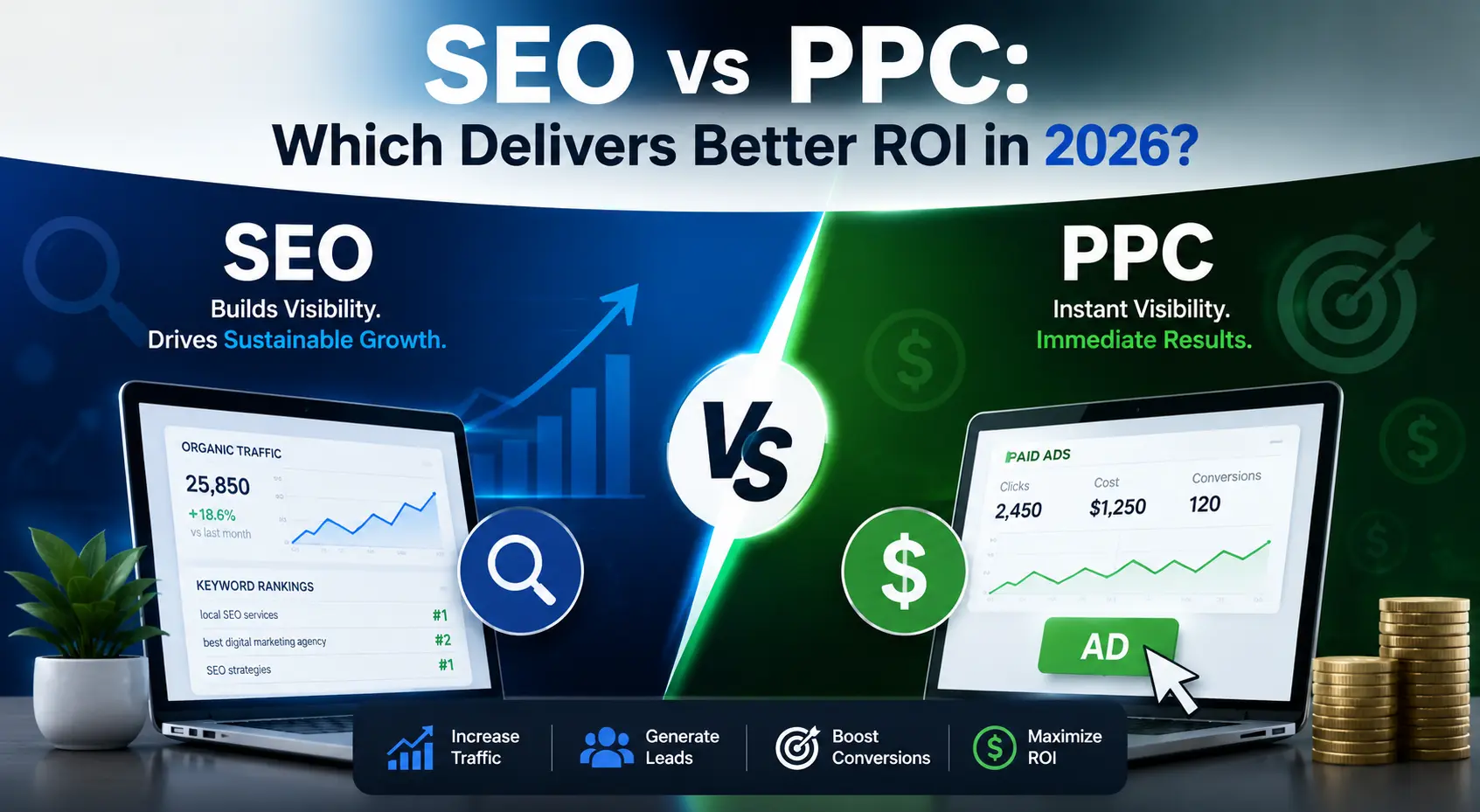
I am confident to say that SEO delivers better ROI than PPC and I am going to prove it. It is obvious that SEO and PPC generate different percentages of ROI (Return On Investment). My experience has shown me that search engine optimization campaigns can generate more than 5 times ROI when compared to PPC (Pay Per Click). It is this difference I would focus on. During my free 30-minute consultation services, many business owners have raised the question about which of them to focus on first.
My answer has always been the same:
New and start up businesses should start with both. PPC brings fast and targeted traffic if done well. However, traffic stops the moment you stop paying for ads. SEO on the other hand takes time before you can see a meaningful organic traffic. In most cases, it can take between 6 and 12 months before the results materialize. Once you see traffic coming to your website, the traffic keeps coming over time and last for a long period of time.
You you then must keep optimizing to sustain your present position in SERPs and to enhance your online visibility even more. I am talking about content gaps, keyword gaps and AI visibility here.
Pros and Cons of PPC and Traditional SEO
Each of these two methods of gaining traffic from search engines have its unique advantages and disadvantages and it is up to you to leverage both to your advantage so your business can grow.
Pros of PPC Campaigns
- You get almost immediate traffic once you have set up your campaign and paid upfront.
- You get quality and high conversion rate by filtering out negative keywords. (More on negative keywords later in one of my next posts. Subscribe to my Newsletter so you get informed).
Cons of PPC Campaigns
- Traffic to your website or to your online property stops the moment you stop stop paymening for paid ads on Google, Bing, Yahoo or some other search engines.
- CPC (Cost Per Click) is becoming higher and higher every day due to fierce competition for positioning. For instance, keywords in the legal field may see up to $25 per click.
- A click to your website or landing page may not convert. You paid for the click but it does not convert. That is a reduction to your ROI if you ask me. Non-converting clicks increase the cost of your bids for relevant keywords.
Most business owners I work with face this exact dilemma of whether to go for PPC first or for traditional search engine optimization. SEO is the process of making sure your site appears in those coveted top search results. It helps you attract the right audience, build credibility, and drive traffic without relying on paid campaigns. PPC, on the other hand, provides immediate results – traffic flows to your website as soon as your campaign goes live.
Data show that users behave and interact differently when confronted with SERP results which search engines display during their searches. I find it fascinating that organic search results have on average a 28.5% CTR while PPC accounts for just 3-5%. This means that people trust organic search results more than they do for paid ads.
It is important that you view this comparison from the perspective that paid ads stop that very moment your budget runs out. On the other hand, traditional SEO continues to drive traffic to your business over a long period of time if you commit to an on-going process of maintenance.
That said, there are compelling reasons for integrating SEO and PPC strategy together which means that you can use cross-channel keyword intelligence for greater efficiency.
This guide examines both approaches to help you determine which brings better ROI in 2026. Whether you are just starting out or reassessing your digital marketing strategy, I will provide the insights you need to make an informed decision.
What Is SEO And How Does It Work?
Before we proceed, I want you to look closely at the comparison table below which shows the basic differences between PPC and SEO.
Comparison Table of SEO vs PPC
| SEO | PPC |
| Your efforts result in sustainable and long-term growth | You get immediate and maximum results. |
| An initial investment is required just to get started. The costs become lower as you progress | You must constantly invest so your campaigns can run. |
| You can expect to see results between three to six months. | You can see results as soon as your ad copies go live, even within an hour. |
| Scalability is natural if you use the right strategy. | Scalability heavily depends on how much you are ready to invest. |
| Your SEO efforts retain value if done properly and well maintained. | Your PPC results stop the moment you run out of funds or stop to pay. |
I am sure I have described what SEO is somewhere on this website. Doesn’t matter, I am still going to explain it anyway. SEO is the acronym for Search Engine Optimization. This is everything you do both on and off your website so that search engines will understand the content and at the same time, make it a resourceful hub for your target audience. Your audience are those people who are searching online for services or products like yours.
The goal is for your website to appear on the first page of Google Search Results. The target is the number 1 position where the most clicks and organic traffic happen. In recent times of AI, you also want your website to be “quoted” in Google AI Overviews as well as in ChatGPT, Perplexity and others. My years of experience have seen proven strategies that when you implement proper SEO, then you can transform your website’s performance over time.
My Explanation of On-Page, Off-Page, And Technical SEO
These three components that I mention are what forms the pillars and backbone of an effective SEO strategy. Each of them has its own distinctive role to play. The combination of these, combined with a solid plan, will surely lead to more traffic, more user engagement and of course, higher rankings on search engines.
“When your website hits the number one position on Google search for queries which users are searching for, you don’t have to be a rocket scientist to figure out what that means for your business.”
On-Page SEO focuses on optimizing individual webpages and their content. This includes strategic keyword placement, creating high-quality content, optimizing meta titles and descriptions, and improving internal linking structures. Everything you control directly on your website falls under this category. I have learned from experience that addressing on-page elements first creates a solid foundation for other SEO efforts.
Off-Page SEO involves activities outside your website that boost its authority and reputation. This primarily includes acquiring quality backlinks from reputable websites, which act as “votes of confidence” for your content. Industry data shows that backlinks remain one of the most important ranking factors as they signal to Google that others find your site trustworthy. Social media engagement and brand mentions also contribute to off-page SEO effectiveness.
Technical SEO addresses the backend elements that help search engines crawl and understand your site more effectively. This includes improving site speed, mobile-friendliness, site structure, and ensuring proper indexing. Without strong technical SEO, even the best content might remain invisible to search engines.
SEO’s Long-Term Value And Organic Reach
SEO delivers sustainable results that add up over time, unlike paid advertising. Usually, businesses who engage in SEO start to see measurable results after 6 to 7 months. Their organic traffic continues to increase as they continue in their efforts. On average, businesses should expect to enjoy a substantial 22% uplift in search visibility and direct clicks during this period. SEO offers an impressive average ROI of 748% – meaning $7.48 return for every $1 invested.
Organic search meets potential customers exactly where they are in their journey. Studies indicate nearly 70% of all clicks go to the top three search results. Ranking well organically positions your company as credible and authoritative without the ongoing costs of paid advertising.
The sustainability factor deserves special attention. Once your organic rankings are established, maintenance costs become lower while visibility persists. Organic search traffic continues even when you pause active development, unlike paid channels that stop producing results immediately when spending stops.
My Personal Opinion
I have been implementing SEO strategies for numerous websites over a long period of time starting in 2007. During theat time, I have come to understand that SEO is not a perfect science. Search engines are somewhat secretive and do not disclose information about their ranking factors. Their algorithms constantly change so they can improve search results. The truth is: What works today might need adjustment tomorrow or may not work at all.
The most effective approach, which I have come to realize, is to focus on the fundamentals: – Create high-quality and helpful content for real people rather than for search engines. Google’s algorithms especially favor websites that provide excellent user experiences and truly solve problems.
My Verdict: Patience remains essential with SEO. PPC campaigns deliver immediate visibility. On the otherside, SEO requires consistent effort before one can see significant results. Most businesses don’t see substantial improvements until 4-6 months in, with the most impressive results appearing after 12 months of dedicated work.
This Is How PPC Works
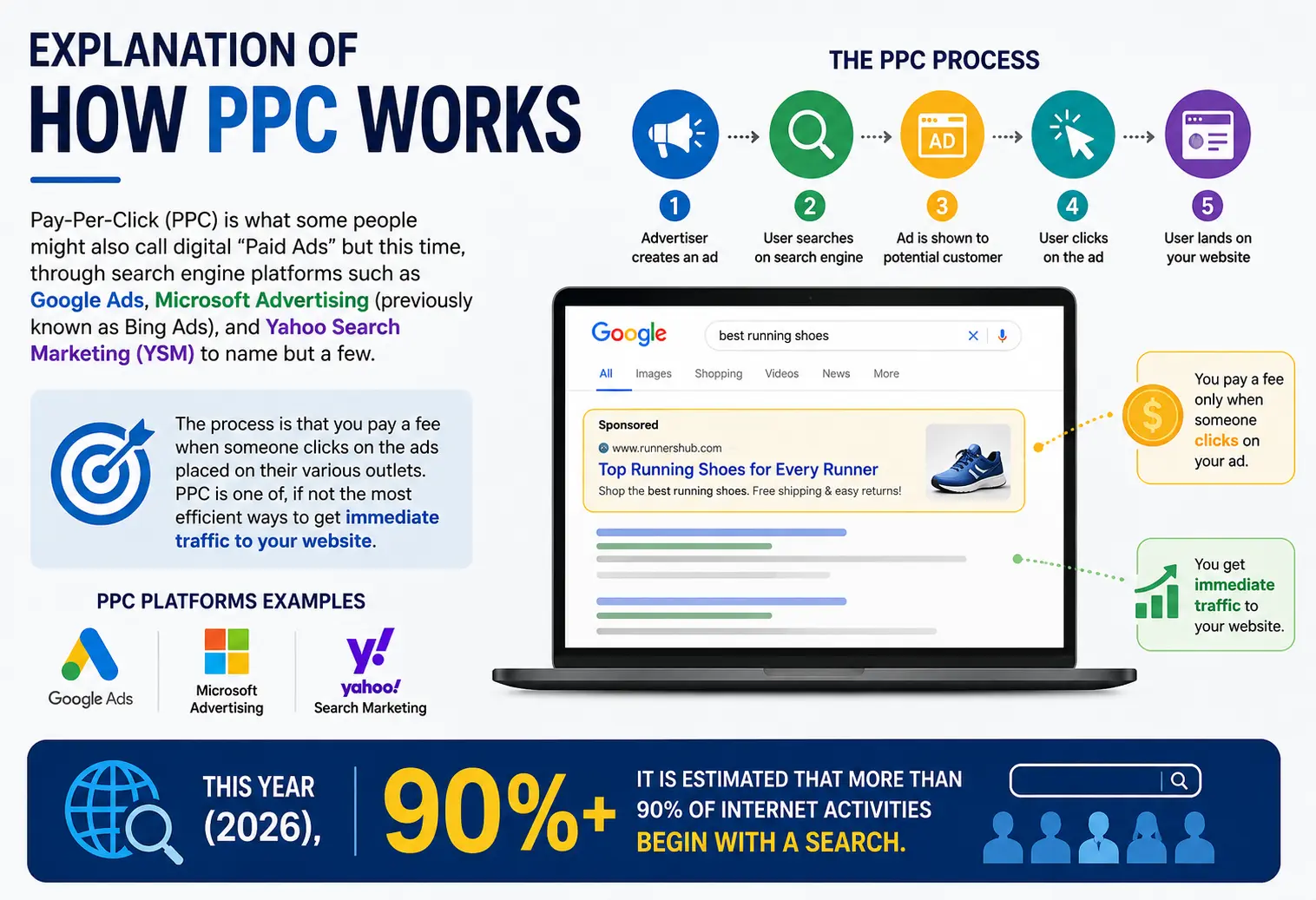
Pay-Per-Click (PPC) is what some people might also call digital “Paid Ads” but this time, through search engine platforms such as Google Ads, Microsoft Advertising (previously known as Bing Ads), and Yahoo Search Marketing (YSM) to name but a few.
The process is that you pay a fee when someone clicks on the ads placed on their various outlets. PPC is one of, if not the most efficient ways to get immediate traffic to your website. This year (2026), it is estimated that more than 90% of internet activities begin with a search.
How PPC Bidding And Targeting Works
This is a delicate part of paid ads. It is basically an auction for position placements. The higher you bid, the higher your ads show up in search results, and the more “eyes” see your placed ads. The image below is an example. It shows results marked with “Sponsored Results” when I typed “SEO expert in Houston, Texas” into Google.
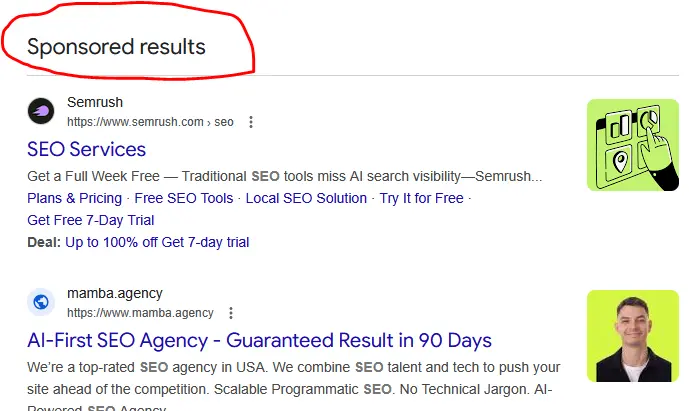
The first step is to have a list of keywords you want to target and for which you want your ads to show. A comprehensive and in-depth keyword research is a must here because failure to do so will cost you money and thus drastically reduce your ROI. One thing to bear in mind is that keyword research for traditional search engine optimization is completely different from keyword research for paid ads.
Keyword Research for Traditional SEO Vs Keyword Research for PPC
A proper and deep keyword research is fundamental for the success of both the traditional search engine optimization and the pay-per-click campaigns but differ in the metrics.
In SEO keyword research, you are looking at keyword difficulties (KD) versus search volumes. You want keywords that are not hard to rank for. These are low keyword difficulties usually 29% or lower by SEmrush and Ahrefs. Keywords with lower KDs usually have lower search volumes while higher KDs are usually associated with keywords with higher search volumes. The trick is to strike a balance. This is why most serious and experienced SEO expert including me go after long-tail keywords which have acceptable search volumes and possibilities to rank faster and easier.
On the other side, keyword research requires a different approach and you look at different metrics. You look at search volumes because keyword difficulties do not have much role to play here. The major metrics you want to look at are search volumes, intent, Cost-Per-Click (CPC) and the percentage of competition. A high Cost Per Click may indicate fierce competition. This also means that the keyword is profitable. Otherwise, why would somebody be ready to pay for a keyword that does not convert? However, there is more to it than you may think.
Cost Per Click Intricacies
Let me right from the start disappoint you. Bidding with a higher rate does not guarantee top spot placement of your ads. Yes you read right, a higer bidding rate does not guarantee that your paid ads will be placed above others. A lower bid cost may outrank you as I will explain shortly.
Google, Microsoft Bing and a whole bunch of search engines use formulas to determine where your ads will be placed. These formulas, though may be different, focus on similar metrics. These formulas are generally referred to as Ad Rank. This is the formula that determines how your ads will be placed. Here are factors that Ad Rank focus on:
Ad Rank = Bid Amount x Quality Score + Other Factors. I want to point to the phrase “Other Factors”. These are metrics, small or big that impact how your ads show up. Remember, neither Google nor other search engines disclose their ranking algorithms. Therefore, most of these metrics were deduced through years of experience as well as testing, testing and testing.
One aspect to pay attention to is the Quality Score which can reduce how much you pay per click for the same position as your competitors who have lower quality scores. Quality score ranges from 1 to 10 and is calculated based on the relevance of your ad copy, the user experience of your landing page and click-through-rate. When you have a 10/10 quality score, there is a big chance that your cost will be lower compared to others who a vying for the same ad position.
One takeaway I want you to always bear in mind is that PPC allows you more precise targeting options as opposed to traditional search engine optimization. You can target specific audiences, based on locations, demographics, age groups, interests and guess what – the browsing behavior of your intended customers.
Note: While implementing all options I outlined in the previous paragraph, make sure you filter out all possible negative keywords. Failure to do so will lead to your ad copy showing up for terms that may not be relevant and thus cost you money. A proper keyword research is the solution to avoid these kinds of situation. There are powerful keyword research tools out there however, my favorites are SEMrush and Ahrefs.
Example: If I want to create an ad copy that targets “SEO expert services in Houston, TX”, I might consider “web design” and “content writing” as negative keywords if I don’t offer such services. I don’t want to create false claims for potential visitors and I sure don’t want to pay if somebody clicks on my ad copy should it appear for such keywords.
There are three major PPC bid types you can choose to do depending on the type of your business and your goals.
- Cost Per Click (CPC): This is the amount you pay when someone clicks on your ad.
- Cost Per Mille (CPM): This is the amount you pay everytime your ad reaches 1,000 impressions.
- Cost Per Acquisition (CPA): This is the amount you pay when someone completes an action. The action may include but not limited to sing-ups, purchase etc.
Ad Types You Can Opt For: Display, Retargeting, Search
There are several PPC formats that can be used to serve various marketing objectives. I am therefore going to explain each of them in the following paragraphs.
Search Ads: This is the most common format used by many marketers. It serves to display your ad at the top of SERPS (Search Engine Results Pages). You see them at the top labeled “Ad” on respective search engine displays. Search ads are tex-based advertisements and appear when a searcher types in your targeted keywords. This type of ads convert the most, the reason why it is a most used format.
Display Ads: These are usually visual in nature and they show across websites that are part of the advertisement network of search engines such as Google Display Networks. In reference to Google, this is called Google Adsense. These are ads placed on websites where the website owner earns a percentage of the revenue whenever their visitors click on the ads. Unlike the search ads, this format can reach up to between 91% to 95% of internet users but convert at a much lesser rate.
Note: I see these kinds of ads on thousands of websites I visit and I can count the numbers I clicked the ads on the fingers of my fingers. Also, what I noticed all along is that these ads are not as targeted (meaning that they may not even be relevant to the content) as compared to Search Ads. In my opinion, their major impact is to build brand awareness for the advertiser.
Remarketing Ads: This is an extremely efficient and profitable marketing strategy. It targets people who, for some reason or the other, did not complete and action after clicking on an ad. Clicks on the ads can indicate their interests, however, they may change their mind “mid-action”. Remarketing Ads serves to display such ads of interest again and again to those internet users with the hope to finally convince them to finalize their actions. In most cases, conversion with this is better than the Display Ads.
Note: I have personally experienced Remarketing strategies over and over again whenever I search for something on the internet. Anytime I visit news websites, ads related or similar to what I was looking for seem to pop up. This confirms that search engines display these Remarketing Ads based on your “Search Behavior” which I will address in some of my blog posts later on in future.
The afore mentioned PPC Ads types are the core but others include Youtube ads, Fabebook ads, as well as across other social medial platforms like Linkedin and Instagram.
My Take On PPC
Even though my major area of expertise is in traditional SEO and of late, Generative Engine Optimization (GEO), and Answer Engine Optimization (AEO), I contributed to various PPC campaigns. As I have mentioned before, Pay Per Click ads can get you targeted traffic within minutes if not seconds of setting them up while on the other hand, search engine oprimization takes a while (months in some cases) to see your first traffic which may not even be targeted enough. I will therefore summarize my take in these following points:
- PPC is powerful in measurability: You have the tools and means to accurately track data such as impressions, clicks and conversion. Your goal should be the top three positions in Search Ads where aproximately 46% of clicks occur.
- PPC has its challenges: It is not a set-and-forget process. You need to optimize constantly and adjust to market trends. Failure to do so will cost you money.
- PPC and SEO compliment each other: A successful marketing campaign should implement these two hand-in-hand. Do PPC for immediate visibility and use SEO for long-term visibility.
Cost Comparison: SEO Investment Vs PPC Budget
The cost is the first thing you want to consider for any marketing strategy you want to implement. Your goal is to make money isn’t it? Each of these approaches has its own unique requirements, budget allocations, returns and delivery timelines.
SEO Requires Upfront Effort and Long-Term Savings
The structure of investment in search engine optimization fundamentally differs from the investment structure of paid advertising. With SEO, you are paying to build long-term resources for organic visibility as opposed to paid ads where you pay for individual clicks. Here is the breakdown:
- People and expertise: A full-blown, enterprise-level SEO team usually includes directors (around $150,000/year), managers ($120,000/year), content specialists ($110,000/year), analysts ($150,000/year) and some other people who do specific tasks.
- Content development: The strongest pillar of SEO is high-quality content which is non-negotiable and which nobody disputes. The investments are directed towards content creation and optimization.
- Technical Enhancements: This, also, as one of the four pillars of search engine optimization is non-negotiable if you want a successful campaign. It addresses site speed, mobile friendliness and website structure amongst other things.
- Tools and software: These software and tools can be used to track ranking positions, conduct keyword research, website audits and a bunch more of tasks.
As you can see, search engine optimization requires upfront investments before you can see significant results. Large companies can invest upwards of $10,000 each month.
Irrespective of the costs, SEO can turn out to be extremely efficient over time. According to some industry data, ROI (Return On Investment) can see an average of 500% over a year.
You may want to read my blog post about how much you can be charged for SEO work in Houston, TX, just so you have an idea of what to expect.
Pay-Per-Click Costs And Budget Control
The money you pay when you go into PPC advertisement is a very straightforward and ongoing thing. You are basically buying visibility of your ads by participating in a bidding system. You set the amount of money you are ready to pay for each click. Mind you, you are competing with other bidders.
The costs of clicks vary dramatically based on the industry. Costs can range from a few cents (CPC) to tens of hundreds of dollars(CPA). The more competitive your industry is, the higher the average Cost-Per-Click (CPC). So far, while conducting keyword research for paid ads, I have noticed that keywords in the legal industry can reach exorbitant heights up to $9 for CPC. Then I came upon an unbelievable CPA rate of $935.71 for the keyword “best mesothelioma lawyer” while, out of curiosity, I was researching for the highest bidding rates in the legal industry.
Small to medium-sized businesses typically have PPC budgets in the range of $1,000 to $10,000 per month. Budgets for more competitive industries are substantially much higher. Here is this formula that most professional use to get the best out of their paid ads investments:
Budget = (Desired Conversions) ÷ (Expected Conversion Rate) × (Average CPC).
Budget control is what I will agree that is the advantasge of PPC because you can control how your money is spent. You can control where, when and to whom your ads are displayed by setting limits. You can set up caps on your spending on daily and monthly basis. Once the caps are met, your ads stop appearing until the next time reset. Therefore, I would say that this enables you to predict the trends from a financial perspective.
One particular feature of PPC which I think has an edge over SEO is the fact that PPC platforms provide you with immediate data on performance and in so doing, enable you to quickly react, improve and optimize your return on ad spend.
I can’t stress this enough. The effectiveness of PPC entirely stops when your budget runs out. Your ads stop to be displayed and your business simply disappears. You therefore are compelled to make your ad campaigns active at all times.
Real-Life Success Story: While I was working as an SEO specialist for a Houston digital marketing company, we had a client whose organic search ranking positions were never above the 40th position. Their traffic mostly came from paid ads. A couple of months after I took charge of taking charge of their organic SEO campaign, their organic traffic surged to over 900% and revenue followed accordingly.
That was when I suggested that we gradually reduce paid ads and gradually move towards SEO because they had already established a solid flow of traffic and achieved higher conversion rates. I must confess that it took a lot of convincing but I eventually succeeded. I documented this achievement in “SEO Success Story Nobody Expected” as testimony that with the expertise, sound knowledge, dedication and with the right mind-set, even the most seemingly tough challenges of search engine optimization can be overcome.
Takeaway
PPC and SEO compliment each other rather than competing for best results. The cost comparison is irrelevant as long as you determine which of them delivers the best value for your business objectives.
PPC can yield results very fasts although at higher costs. Businesses can use PPC to test the market before they can commit to investing larger amounts of money on SEO.
SEO has between 8 to 12 months before you cross the threshold of financial efficiency. That is around the time you can begin to notice acceptable level of ROI (Return on Investment). This makes SEO particularly valuable for established businesses with proven market fit. However, one thing to bear in mind is that this kind of positive results come if and only if you conduct your search engine optimization campaign the right way.
What most successful companies do is start by splitting their budget in a 70/30 or 60/30 manner in favor of PPC and gradually shift towards SEO as their organic performance improves.
Traffic Sustainability: Organic Growth Vs Paid Surge
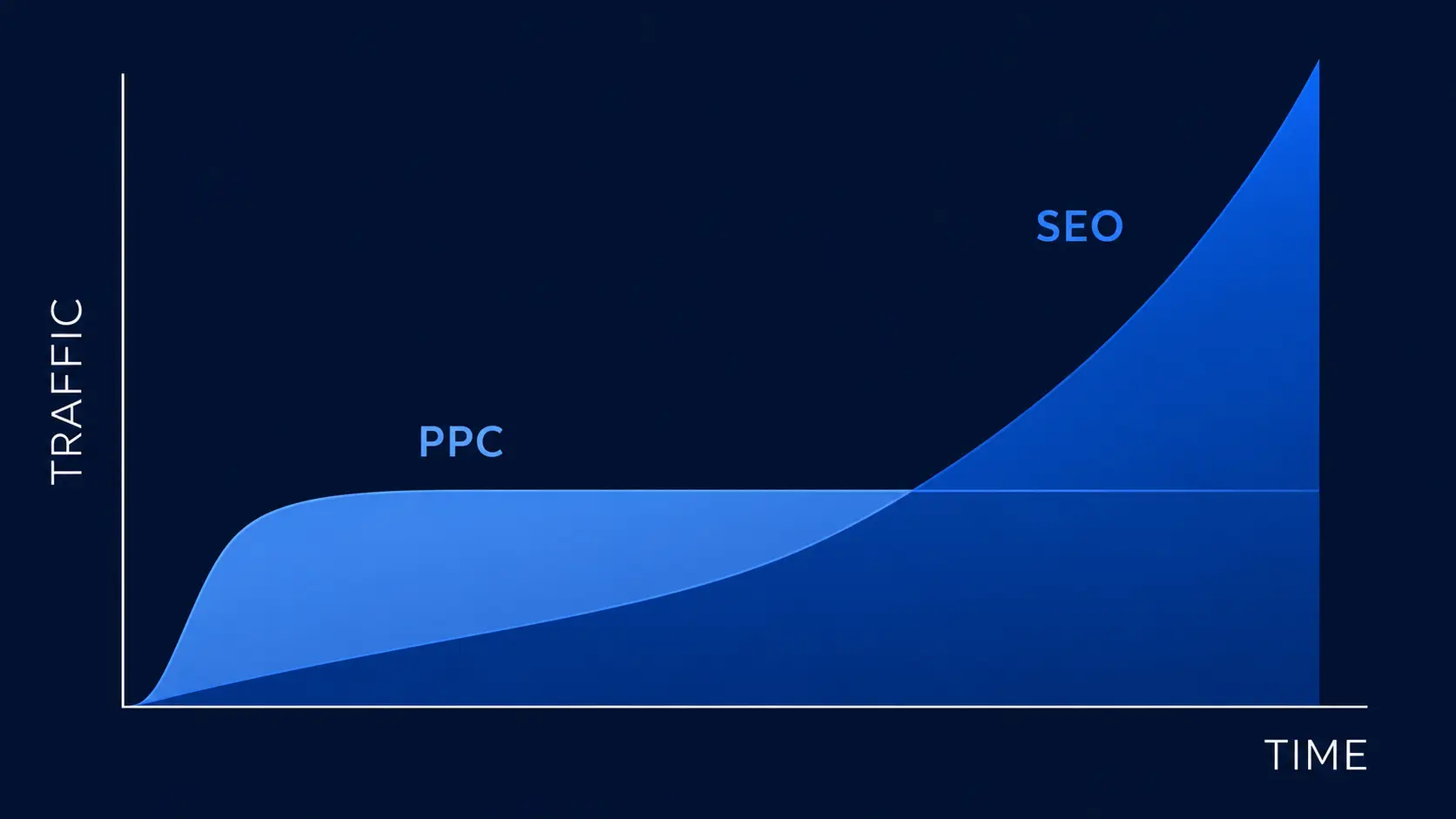
The everlasting question which most business owners frequently ask concerning paid and organic traffic sources is, “what happens to my website traffic tommorrow?” This fundamental difference shapes how SEO and PPC campaigns deliver value over time.
SEO Compounds Traffic Over Time
Organic traffic that comes through the best practices of SEO gradually builds up and strengthens with time. Why is this so special? Here is why:
According to various studies, organic traffic comes from a significant portion (around 33%) of website visitors. The more reason why businesses should not ignore traffic pipeline.
It is the aspect of sustainability that sets organic traffic apart from other methods of marketing. High quality and well optimized content has no “expiration date”. A well optimized page can continue to rank well for months or even years after it has been published. This creates a compounding effect where each piece of content adds to your traffic baseline.
Performance With PPC Is Instant But Temporary
The advantage of PPC is that the campaign can be launched with hours and you can start to get traffic within the next hour after the launch, of course provided the campaign was created the right way.
It is also perfect if you want to test marketing trends for time-sensitive marketing promotions. The drawback is that it stops the monent you stop paying. The temporary nature can further have an impact on the way you plan your marketing strategies.
My Personal Take:
After years of working and practicing both approaches, I have come to realize that traffic sustainability of both approaches should be viewed from different perspectives. Each of the channels serve different purposes but they compliment each other for marketing success.
I like to think that when you engage in SEO, you are practically building your own house to comfortably live in afterwards. On the other hand, I view PPC as renting and apartment where you can move in immediately. No matter how much and how long you pay, it can never be yours. You continue to live there as long as you continue to pay your rent. Once you stop paying, you get kicked out. That is how I see it.
Click-Through And Conversion Rates
The Key Differences of Sustainability Between PPC And SEO
SEO and PPC CTR Comparison
| SEO (Organic) | PPC (Paid) | |
| Speed | Slow: Can take momths to years. | Fast: Almost immediate from minutes to hours. |
| Cost Model | Requires time, labor and initial investments. | Pay-Per-Click. |
| Traffic Lifespan | Sustainable and long-term. | Temporary. Ends when you stop paying. |
| Click-Through-Rate | Generally higher for top search positions. | Lower because users often skip ads. |
| Primary Goal | Brand authority and trust. | Conversions and immediate sales. |
It is a good thing to rank as higher as possible by engaging in SEO with the coveted first position on the SERPS being the goal. It is a wonderful thing for your ad copies to rank first on search queries. All these high rankings both on organic searches and paid searches bring tons and tons of traffic to your site. But real success is not measured by the sheer traffic volunme, it definitely is not measured by the click-through rates but measured through conversion.
Conversion is when a visitor comes to your website or landing page and takes the action you want them to take. These actions vary based on why you set up your campaign in the first place.
Possible actions can be, but not limited to, buying the product you are promoting, to sign up for a subscription, to view and download an offer, to hire your services etc.
Note:* If you get tons of traffic coming to your website and landing page(s) but very few or no actions are taken by visitors when they land on your pages, then something is wrong. The most probable cause is that your content is not convincing enough. I wrote a blog post about how to create content for success and I would encourage you to read it.
Click-Through Rate (CTR) Benchmarks For SEO Vs PPC
There is a huge, and I mean, huge difference in visitor click behavior between organic and paid results. Most studies, including the ones I conducted myself show that if you rank number one on organic searches, you stand to command over 37% CTR of the traffic whereas, traffic from paid ads can command a CTR of a little over 3%. CTR Benchmarks For SEO Vs PPC
The contrast in click behavior between organic and paid results is striking. Position #1 organic results average a commanding 37.15% CTR, whereas paid search ads typically achieve just 3.17%. This translates to organic results capturing 75% of all clicks on search results pages, with paid results receiving only 25%.
If you want to start a campaign in PPC, I want you to do a little bit of research and analytics of the trending data specific for your industry before you ever get started. I gathered some data regarding click-through rates for various industries and I am ready to share them with you. The highest CTRs come from industries such as dating and personals (around 65.1%), travel (4.7%) and advocacy (4.4%).
Ranges of CTR By Industry
| Industry | Search (SEO) | Display (PPC) |
| Legal & Attorney Services | 2.7% - 3% | 0.4% - 6% |
| Dating & Personals | 5.9% - 6% | 0.4% - 0.73% |
| Real Estate | 3.5% - 3.71% | 0.9% - 1.06% |
| Health & Medical Services | 3.20% - 3.27% | 0.51% - 0.58% |
| B2B | 1.98% - 2.41% | 0.4% - 0.47% |
| Finance & Insurance | 2.62% - 3.01% | 0.46% - 0.52% |
| Travel & Hospitality | 4.23% - 4.68% | 0.33% - 0.47% |
| Construction | 3.01% - 3.88% | 0.34% - 0.37% |
| Restaurants & Food | 4.23% - 4.98% | 0.87% - 1.03% |
| Education | 5.01% - 5.67% | 0.49% - 0.53% |
| Career & Employment | 5.65% - 5.92% | 0.55% - 0.59% |
| HVAC | 3.71% - 4.00% | 0.33% - 0.39% |
Note:* The data show above in the table covers just a small section of industries. I have limited the numbers for the sake of available sapce on this website. Other sources may vary depending on various metrics including, the tools used to measure, the benchmarks standards and the number of industries analyzed.
High-intent industries like legal and healthcare enjoy stronger engagement because users seek quick, trustworthy solutions. SERP features dramatically influence click behavior. Google’s AI Overviews can reduce organic CTR by 61% and paid CTR by 68%.
Conversion Rate Trends In 2026 And Beyond
I would first of all like to address the current trending data and later express my predictions for future conversion rates. Bear in mind that conversion rates vary from industry to industry. The average conversion rate with SEO is around 14.4% as compared to just 3.78% with PPC (0.76% for display advertising) and when you couple that with organic leads closing at 8 times more, then you get the picture that SEO has a significant advantage over PPC.
Some data show that in 2026, legal services seem to be leading with an average of 7.5% conversion rate with organic searches when compared to just 2.2% with PPC. The thing is: Most industry sectors see conversion rates in SEO outperforming PPC, however, the exception is with higher education where PPC outperforms SEO with a 1.7%/1.4% ratio.
We all know that trust signals add up to help boost conversion rates. Once your customers trust your business, they eventually become loyal. You should therefore incorporate social signals into your ad copy. In so doing, you can increase your conversion rate by 1% which can be significant even though you may think that 1% is too little. Every positive percentage counts if you ask me. The benchmark to these trust signals also vary depending on your business model. For instance, local businesses convert at an average between 3% to 7% while ecommerce can convert between 1% and 4%.
The Takeaway I Want To Give You
Click-Through-Rates (CTR) and Conversion Rates (CR) are data which tell different parts of the same story. When you have high CTR, that signifies relevance to what searchers are looking for, but success is by no means guaranteed. Yes, high click-through-rates increase your chances, however, if conversions are relatively low, then maybe you need to take a closer look at your ad copy (in case of PPC) and your on-page content (in case of SEO).
It is always a good thing to stive for a balance between traditional SEO and PPC. This is not a strategy that one should lightly and one should look beyond the surface metrics. Again, I always advise clients who are in high-intent industries like healthcare and legal services to start with PPC for immediate results while building on SEO for long-term conversion strength.
CTR comes with high intent which is why SEO conversion rates outperforms conversions with PPC.
My advice? Track both metrics but prioritize conversions over clicks. A modest 2% CTR that converts at 5% will outperform a flashy 10% CTR that converts at 0.5% every time.
ROI Metrics: Which Channel Delivers More Value?
Now let’s discuss the most important aspect because money talks as they say which is the major reason for your marketing campaigns in the first place. Return On Investments (ROI) metrics are your focus. These metrics determine which channels bring you better value for your marketing dollars, PPC or SEO or both.
Let’s Compare Cost Per Acquisition (CPA)
You will get a clearer picture when you examine cost per acquisition across various channels. I will use some examples I happened to be a witness of. An ecommerce business, after a campaign of 5-12 months, saw the cost of their SEO-driven traffic at between $7.4 – $26 per customer acquisition while their PPC-driven traffic cost $25-$80 per customer.
Another example is a Commercial Insurance company that allocated $250,000 to SEO and here is what their investment yielded:
- They had an aproximate number of 11,000 new visitors within a year.
- Out of the new visitors, they had 191 qualified leads and signed up 38 new clients.
- This translated to a remarkable $823,000 profit.
Meanwhile, their PPC investment yielded a totally different outcome entirely. The same budget with PPC yielded 8,500 new visitors within a year, 77 qualified leads and 15 new clients. This campaign generated around $185,000 profit.
Lifetime Value (LTV) Of SEO Vs PPC Leads
I came across this term, Lifetime Value, while taking a digital marketing course at the time I was still on my journey into becoming an SEO expert. My translation of this term is simply a combination of customer trust, loyalty and retention.
I reviewed some data both from our PPC campaigns and SEO efforts for a number of our clients. The data clearly showed that customers we acquired through search engine optimization were more loyal and trust us more than the customers we acquired through advertisements. The thing is, customers discovered our clients’ brands through educational content where we succeeded to build relationships with them.
Once again, PPC is perfect for testing trends on the market and precise targeting. SEO helps to build long-term relationships.
When You Should Use PPC, SEO Or Both
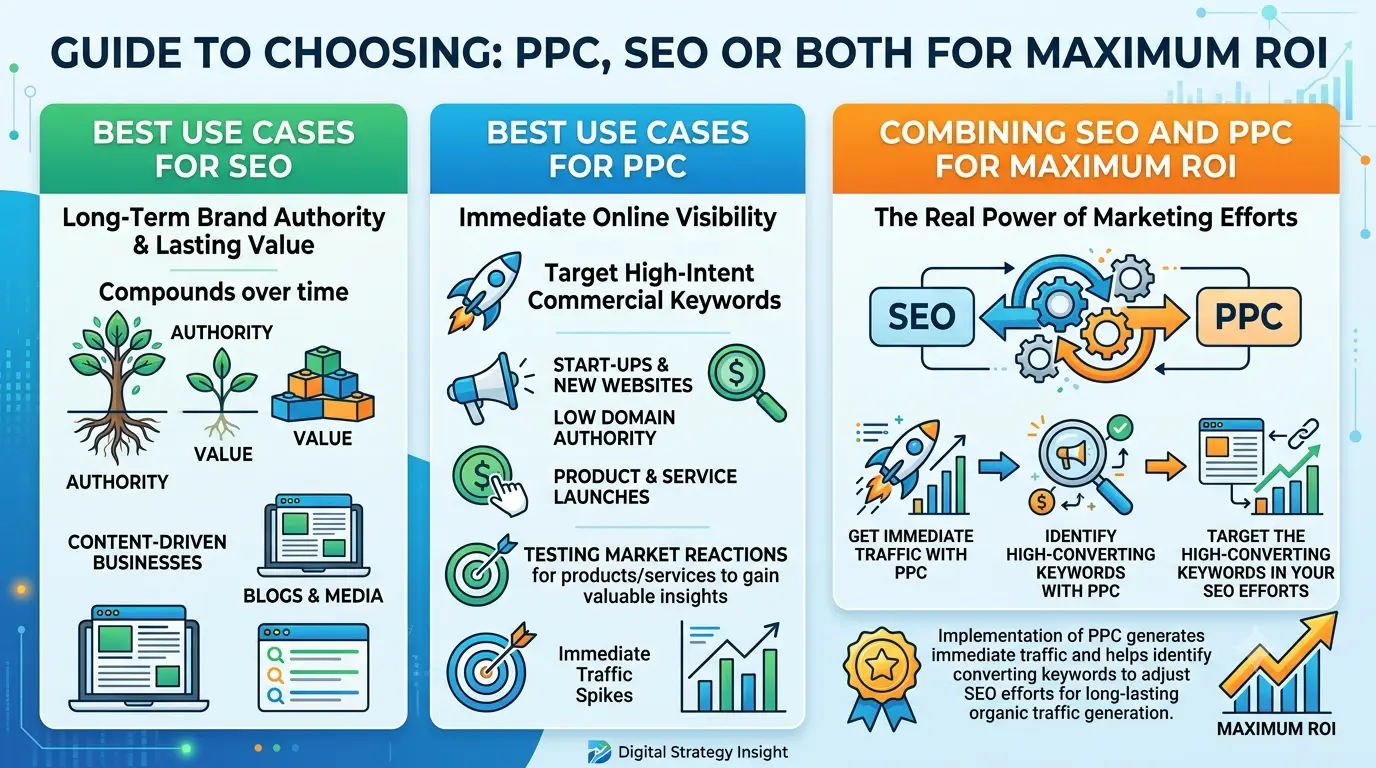
If you have been reading this post to this level, and you have been paying attention, I am sure you must have deduced where I stand on these issues. when should you use SEO, when should you use PPC and when should you use both. At this point, I will explain with best use cases of each of the strategies. The strategies I have implemented for clients I have worked with and still working with.
Best Use Cases For SEO
As I have mentioned so many times in this post, search engine optimization works best when you are aiming for long-term authority for your brand. In that way,you get a lasting value that compounds over time. I have come to understand that content-driven businesses have immensely benefited from this kind of business model. And yes, these businesses use blogs and media to further enhance their organic search presence.
Best Use Cases For PPC
When you need immediate online visibility, and you want to target high-intent commercial keywords, then PPC is the perfect choice. I recommend this strategy for start-ups, new websites with little or no domain authority, or when you launch new products or services. You can use this method to test for the reaction of the markets for your newly launched products or services. In so doing, you gain valuable insights into how your products or services will fare moving forward.
Combining SEO And PPC For Maximum ROI
The real power of a successful and profitable marketing efforts come into play when you combine both PPC and SEO. The implementation of Pay-Per-Click, aside from it’s immediate generation of traffic, will help you to identify which high-intent keywords convert the best and thus go ahead and adjust your SEO efforts to target those same keywords for long-lasting organic traffic generation. Simple as that.
The end results or combining both methods are that:
- You get immediate traffic with PPC
- You identify high converting keywords with PPC
- You then target the high converting keywords in your SEO efforts.
Common Mistakes In SEO And PPC Campaigns
You will not be human if you don’t make mistakes and that also applies to digital marketing as well as to everything else. Mistakes do happen even with a wll planned campaign. These mistakes are usually the fundamental one which, due to some reason are overlooked. We have addressed different aspects of PPC and SEO in this post and now, it is time to look into missteps that can wreck a seemingly flawless strategy.
SEO Pitfalls: Ignoring Technical SEO Or Content Gaps
What I have noticed as one of probably the biggest mistakes is not paying proper attention to technical aspects of a website from the onset, I mean from the first steps in designing a website. Most people are enchanted with a stunning website that looks beautiful, but, have all the technical flaws been taking care of? Technical errors of a website are not visible to the naked eye. I spelled out what to do and how to build a website by following the best practices of technical SEO in one of my previous posts.
Content is another important foundation of digital marketing. I don’t just mean content, but high-quality content. The content must resonate with your target audience before you can expect any tangible results. This is also a non-negotiable element.
PPC Pitfalls: Poor Targeting Or Weak Landing Pages
While I was still polishing my expertise at PPC, I took some time to investigate competition ad copies. What I discovered might surprise you. I discovered that some ad copies did not aligh with the content of the landing pages. My conclusion was that some ads serve to lure potential customers to the landing pages in hope of convincing them with bogus claims. However, this kind of practice can and will surely back fire.
The bottom line is that you must align your ad copies with the content on your landing pages. If visitors detect deception, trust me, search engines too will, and your website may face penalties.
An Important Takeaway
I have audited many failing campaigns during my career and have come to this conclusion: Success comes from a simple word – alignment. Your keywords, your ad copies, your landing pages must all align with each other. Then comes the post-click experience which measures how visitors interact with your pages. Failure to abide by these basic rules can make you pay for visitors that don’t convert.
Comparison Table of What We Have Covered
At this juncture, I would like to present a comparison table on all basic strategies we have covered and to compare the most important figures which will (I hope), enable you to draw up your strategies whether you want to focus on PPC or SEO or both.
Breakdown of What We Covered
| Comparison Factor | SEO | PPC |
| Initial Investment | $500 - $5,000/month (small-mid businesses), $10,000+/month (large companies) | $1,000-$10,000/month (small-mid businesses) |
| Timeline for Results | 6-12 months for positive ROI | Immediate results |
| Click-Through Rate | 37.15% (Position #1) | 3.17% (average) |
| Conversion Rate | 14.6% average | 3.75% (search), 0.77% (display) |
| ROI | 500%+ over 12 months, 748% average return | Varies by industry, immediate but requires continuous investment |
| Traffic Sustainability | Continues after investment stops, compounds over time | Stops immediately when spending stops |
| Cost Per Acquisition | $8-$25 per customer (after 6-12 months) | $25-$80 per customer (ongoing) |
| Best Use Cases | - Long-term brand authority - Content-driven businesses - Limited marketing budget - Building lasting digital assets | - Immediate visibility needs - New product launches - Market testing - High-intent commercial keywords |
| Key Challenges | - Requires significant upfront effort - Results take time - Constant algorithm changes | - Ongoing costs - Message misalignment - Landing page optimization - Increasing competition and costs |
And Finally
Now that we have addressed the most approaches across multiple dimensions, the choice between PPC and SEO depends first on your business goals, your timeline, and the resources you have available. Bear in mind that each of these strategies has its own dinstict advantages and disadvantages. Your responsibility is to pick which one best suits your business goals.
As we have seen throughout this article, SEO stands out for long-term value creation. The data consistently shows superior ROI over time because organic traffic continues to flow even after you complete the initial optimization work. Patience remains core because most businesses need between 6 to 12 months before they see substantial returns. It is the compounding nature that makes SEO unmatched for sustainable growth.
On the opposite side of traditional search engine optimization, PPC excels when you need immediate results. You can launch campaigns today and see traffic tomorrow and in some cases even within an hour of ad placement. This makes it perfect for time-sensitive promotions or for new businesses who require quick visibility. The precision targeting capabilities allow you to reach specific audiences with remarkable accuracy, but your visibility disappears the moment you stop to pay for ad placements.
The cost structures for both approaches differ. With Seo, you need to make a significant investments upfront but these investments become minimal once your positions on SERPs have been established. The cost of placed ads can vary depending on the industry your business is in as well as how fierce the competition is. These fundamental differences are the determinants of how each strategy can deliver returns over time.
User behavior is another aspect we have covered. We have seen that organic traffic capture the majority of clicks when you rank at the top positions on SERPs. They also outperform paid ads in both click-through-rates as well as conversion rates. On the other side, paid ads allow you to precisely target your audience and potential customers, the process of which enables you to get immediate feedback on how your ads are performing.
What I have learned (and I also hope you too have by reading this blog post) is that the best approach is to integrate these two into your marketing trategies rather than make them compete against each other for optimal results. Make them work together and not compete with each other so you can maximize your visibility all throughout your marketing journey.
I want you to be aware that the digital marketing landscape is constantly changing and as such, you should adapt your approaches accordingly. AI Overviews, GEO (Generative Engine Optimization), AEO (Answer Engine Optimization) are shaping online searches and how searches are conducted. Therefore, you should embrace these trends if you want to stay in the game or else, your business might be blown into oblivion.
The Bottom Line Comes To All These
Understanding the ROI differences between SEO and PPC will help you to make smarter marketing investments that align with your business timeline and budget constraints.
- SEO delivers superior long-term ROI: With an average 748% return and sustainable traffic that continues after investment stops, SEO outperforms PPC financially over a period of 12+ months.
- PPC provides immediate visibility but it requires continuous spending: While PPC delivers instant results and precise targeting, traffic disappears completely when campaigns end. Your are therefore compelled to keep paying so your business can stay visible.
- Organic search captures 75% of clicks with higher conversion rates: Position #1 organic results achieve 37.15% CTR versus 3.17% for paid ads, plus SEO converts at 14.6% compared to PPC’s 3.75%.
- Integration strategy maximizes results: Use PPC for immediate market testing and keyword data while building SEO for long-term authority—most successful businesses start 70/30 PPC then shift toward SEO.
- Timeline determines strategy choice: Choose PPC for immediate needs like product launches or cash flow generation; select SEO when building lasting brand authority with 6-12 month investment horizons.
The most effective approach isn’t choosing between SEO and PPC, but understanding how to leverage both strategically. PPC tests market demand and provides quick wins while SEO builds the sustainable foundation that delivers compounding returns over time.
FAQs
Q1. Which strategy delivers better long-term ROI: SEO or PPC? SEO typically provides superior long-term ROI, with an average return of 748% over 12 months. While PPC offers immediate results, SEO’s compounding effect leads to sustainable traffic growth and lower costs per acquisition over time.
Q2. How long does it take to see results from SEO compared to PPC? PPC campaigns can generate immediate traffic, while SEO usually requires between 6 to 12 months to show significant results. However, once established, SEO continues to drive traffic even after active investment stops, unlike PPC which ceases immediately when spending ends.
Q3. What are the click-through rates for organic vs. paid search results? Organic search results generally outperform paid ads in click-through rates. The top organic result averages a 37.15% CTR, while paid search ads typically achieve around 3.17% CTR.
Q4. How do conversion rates compare between SEO and PPC? SEO tends to have higher conversion rates that averages around 14.6% across all industries. In contrast, PPC conversion rates average 3.75% for search ads and 0.77% for display ads. However, rates can vary significantly by industry and campaign quality.
Q5. Should businesses focus on SEO or PPC for their digital marketing strategy? The most effective approach is often to use both SEO and PPC in a complementary strategy. Start with a higher PPC budget for immediate visibility and data collection, then gradually shift towards SEO as organic rankings improve for long-term sustainability and cost-effectiveness.
Explanations of SEO Acronyms Used in this Post
1. PPC: Pay Per Click. This is associated with paid ads. You pay for every click when your ad is clicked on by a searcher.
2. CPC: Cost Per Click. This is the average amount of money you pay when your ad on search engines is clicked by a user.
3. SERP: Search Engine Results Page. This is the page that Google, Bing, Yahoo and other search engines display for a search query.
4. CTR: Click Through Rate. This is the percentage of clicks to your website by visitors when your website is displayed on search engine result page.